 Valerio's Cave
The role of the CTO when a company enters “crisis mode”: what really changes
The role of the CTO when a company enters “crisis mode”: what really changes
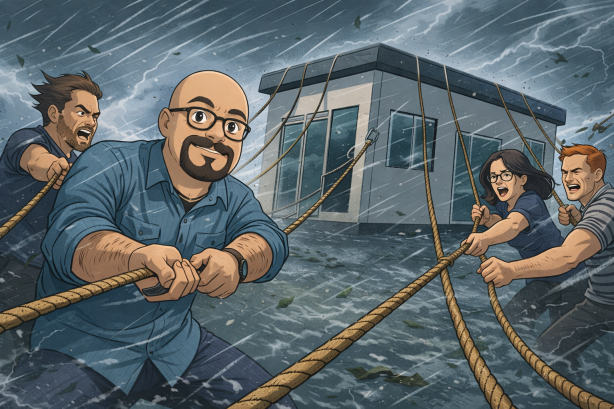
Sooner or later, it happens.
It doesn’t matter how solid the company is, how competent the team is, or how good the product may be.
At some point, something stops working the way it should.
A key client leaves.
Margins start shrinking.
The market shifts faster than expected.
Or problems simply surface that had been hidden beneath the surface.
At moments like this, the company enters what we could call “crisis mode.”
And the role of the CTO changes—often far more deeply than people expect.
First of all: let’s remove the heroic narrative
When people talk about leadership during a crisis, the dominant narrative is almost always the heroic one.
The leader who saves the company.
The visionary who finds the impossible solution.
The genius who turns the situation around with a brilliant move.
In reality, none of this usually happens.
The real work is far less spectacular and much more analytical.
The CTO during a crisis is rarely the hero.
More often, they become something else:
a clear-eyed observer of the system.
What really changes in day-to-day work
When a company enters a difficult phase, the first thing that changes is the type of technical decisions being made.
In normal times, conversations revolve around:
- architecture
- scalability
- technical debt
- technology roadmap
- code quality
During a crisis, the questions suddenly become different:
- what can we cut
- what can we simplify
- what can we delay
- what is no longer truly necessary
This is a very sharp shift in perspective.
Technology stops being a field of optimization and returns to what it has always been:
a tool to support the business.
The real shift is psychological
The most important transformation, however, is not technical.
It’s psychological.
When a company enters crisis mode, several fairly predictable things tend to happen:
- anxiety increases
- opinions multiply
- the ability to listen decreases
- the need to find someone to blame grows
The team feels the pressure.
Management feels the pressure.
And of course, the CTO feels it too.
In this context, the biggest risk is not a wrong technical decision.
The real risk is the loss of collective clarity.
The CTO as a stabilizer of the system
This is where one of the least discussed aspects of the CTO role emerges.
Not so much as a builder, but as a stabilizer.
In practice, this means doing a few very simple—but very difficult—things:
- keeping discussions grounded in facts
- preventing unnecessary emotional escalation
- separating real problems from noise
- protecting the team from organizational chaos
It’s not a spectacular position.
But it is often the role that allows the organization to keep functioning while everything is under pressure.
Some useful perspectives
There are no universal recipes for navigating these moments.
Every company has its own dynamics.
However, some perspectives tend to be helpful.
1. A crisis reveals the company’s real structure
Many processes work well as long as things are going well.
A crisis shows which ones were solid—and which ones were only apparent.
2. Simplicity becomes a strategic advantage
Overly complex architectures, overly articulated processes, and overly ambitious roadmaps suddenly become a burden.
3. People observe more than we think
During difficult phases, the team carefully watches how leadership behaves.
Not so much what it says.
But how it reacts under pressure.
A brief moment of realism
It’s also worth saying this clearly.
Sometimes crises are resolved.
Sometimes they aren’t.
Sometimes companies reinvent themselves.
Sometimes they scale down their ambitions.
Sometimes they simply go through a difficult phase and eventually recover.
The CTO does not control all of these variables.
And perhaps that is the hardest thing to accept.
A simple conclusion
When a company enters crisis mode, the role of the CTO changes.
Less futuristic vision.
More analysis.
Less optimization.
More simplification.
But above all, the kind of leadership required changes.
What’s needed is not a hero.
What’s needed is someone capable of remaining clear-headed while everything else becomes noisy.