 Valerio's Cave
How Kubernetes Changes the Failure Model of Your System
How Kubernetes Changes the Failure Model of Your System
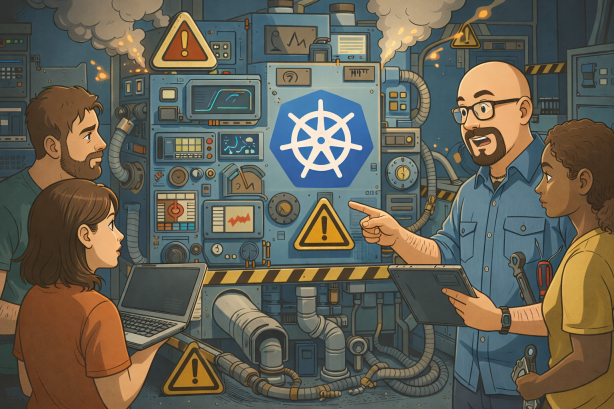
Kubernetes is not just a container orchestrator.
It represents a fundamental shift in how your system fails.
Many teams adopt Kubernetes thinking in terms of scalability, deployments, and automation.
But the real impact — the deeper and often underestimated one — is on the failure model.
And if you don’t update your way of thinking, Kubernetes won’t make your system more robust.
It will simply make it more complex.
From Deterministic to Probabilistic
Before Kubernetes, most systems were implicitly deterministic:
- known servers
- localized failures
- relatively stable infrastructure
If a server went down, you knew it.
If a process crashed, you saw it.
With Kubernetes, you enter a probabilistic world:
- pods are ephemeral
- scheduling is dynamic
- restarts are automatic
- topology constantly changes
You can no longer ask:
“Will the system fail?”
You must ask:
“When will it fail, and how?”
Failure is no longer an exception.
It is a property of the system.
Invisible Failures and False Reliability
One of the most dangerous effects of Kubernetes is that it hides local failures.
- a pod crashes → it gets replaced
- a node dies → workloads are rescheduled
- a container fails → automatic restart
From a superficial point of view, everything seems to be working.
But underneath:
- transient errors increase
- silent retries mask issues
- slow degradations go unnoticed
This creates a false sense of reliability.
Kubernetes doesn’t eliminate failures. It makes them less visible.
And when they surface, they often do so at a systemic level.
Kubernetes Is Not Resilience
One of the most common myths:
“If I use Kubernetes, my system is resilient.”
That’s not true.
Kubernetes does not make your system fault-tolerant.
It exposes your architectural flaws.
Concrete examples:
- non-idempotent services → issues with automatic retries
- synchronous dependencies → cascading failures
- centralized database → unchanged single point of failure
- misconfigured timeouts → resource saturation
Kubernetes is not fault-tolerance. It is fault-exposure.
The New Blast Radius
Before:
- a failure was often confined to a single machine
After Kubernetes:
- aggressive retries
- autoscaling
- service mesh
- dynamic load balancing
can turn a small error into a global problem.
Typical examples:
- retry storm
- thundering herd
- downstream service saturation
The blast radius is no longer physical.
It is logical and distributed.
Observability: From Optional to Survival Requirement
In a Kubernetes system:
- logs are not enough
- isolated metrics are not enough
- correlation is required
What becomes essential:
- distributed tracing
- event correlation
- end-to-end visibility
If you cannot observe the system, you are not really managing it.
In Kubernetes, if you can’t observe it, you don’t own it.
The Skill Set Must Evolve
Kubernetes is not just a technological shift.
It is a cultural one.
Developers need to understand:
- retries
- timeouts
- circuit breakers
- idempotency
Ops need to understand:
- application behavior
- service communication patterns
This leads to a true Platform Engineering mindset.
There is no longer:
“this is not my problem”
The system becomes a shared responsibility.
Testing Is No Longer Enough
Traditional testing is no longer sufficient.
You need to introduce:
- failure injection
- chaos engineering
- testing under realistic network and load conditions
Because many issues only emerge:
- under stress
- in distributed environments
- over time
The Time Dimension of Failure
With Kubernetes, problems become:
- transient
- intermittent
- hard to reproduce
A bug can:
- appear for a few seconds
- disappear after a restart
- never show up in local environments
Debugging changes fundamentally:
It is no longer a snapshot. It is a timeline.
The Cognitive Cost
Kubernetes introduces significant complexity:
- more layers (container, pod, node, cluster)
- more abstractions
- more failure points
Root cause analysis becomes harder.
Kubernetes is a multiplier of complexity, not just scalability.
And this complexity has a cost:
- slower onboarding
- harder debugging
- stronger dependency on observability tools
When NOT to Use Kubernetes
Kubernetes is not always the right choice.
It might not be if:
- the team is small or inexperienced
- the system is simple and monolithic
- there are no real distributed scalability needs
- there is no maturity in observability and resilience
If you don’t already have distributed problems, Kubernetes might introduce them.
Conclusion
Kubernetes does not make your system reliable.
It makes your system honestly unreliable.
It forces you to:
- treat failure as part of design
- improve your engineering practices
- grow as a technical organization
And that is exactly where its value lies.
Kubernetes doesn’t solve problems.
It forces you to actually see them.