 Valerio's Cave
CTO and burnout: how to recognize it and react without losing clarity
CTO and burnout: how to recognize it and react without losing clarity
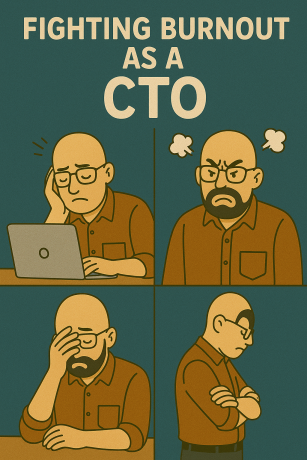
Being a CTO today means standing at the intersection of business, technology, and people. It’s an exposed role: you’re always “on call”, even when there’s no pager going off.
The truth is simple and uncomfortable: clarity is a technical resource just like uptime.
If it goes down, everything else follows: decisions, team, roadmap, strategy.
In this article I’m speaking to you as a peer: someone who writes code, designs architectures, keeps an eye on cloud costs and, at the same time, carries home the meetings, team issues, and board expectations.
Early signs of burnout (before it becomes a major incident)
Burnout doesn’t show up overnight: it accumulates. Like latency slowly increasing until a service stops responding.
Some common signals, especially for those leading the technical side:
“Weird” loss of focus
- You reread the same issue three times and still don’t decide.
- You postpone decisions you’d normally take in 10 minutes.
- You keep switching tasks without closing anything.
“Selective” loss of enthusiasm
- You still enjoy technical problems, but alignment calls and strategic discussions drain you.
- You catch yourself thinking: “I just want to write code, that’s it.”
Low-threshold irritability
- A small regression drives you mad.
- A question from the team feels like “yet another weight”, not normal support.
Body in constant alarm mode
- Fragmented sleep, waking up at night thinking about tickets or deadlines.
- Chronic fatigue, even on “light” days.
Isolation disguised as efficiency
- “It’s faster if I do it myself.”
- You pass fewer and fewer problems to others and end up centralizing everything “for the good of the team”.
If you recognize yourself in even two or three of these points, it’s not a disaster yet… but it’s a serious alert: it’s like seeing the error rate rise above the threshold: it’s not downtime, but you can’t ignore it.
How to create healthy boundaries (without looking less like a leader)
As a CTO it’s easy to live in infinite availability mode. But infinite availability is, by definition, not scalable.
Some very practical, healthy boundaries:
Declared and respected working hours
- It’s not enough to tell yourself “I work until 6 PM”: communicate it to the team.
- Put your availability windows in your Slack status.
- Avoid sending evening messages unless it’s a real incident (scheduling send for morning is a powerful gesture).
Shared channels and priorities
- Define what goes through Slack, what through ticketing, what by email.
- Clarify what counts as an “incident” and what is “fast track”, so not everything becomes urgent.
Agenda defended, not just filled
- Block fixed slots for deep work (and treat them like meetings with the CEO: they don’t move for anything).
- Schedule a decompression slot between critical meetings, even just 10 minutes.
Honest technical “no’s” and “not now’s”
- Learning to say “not now” to projects and requests is an act of leadership, not weakness.
- Shift the conversation to priorities and team capacity, not “I don’t feel like it”.
Boundaries don’t distance you from the team: they make you more predictable, healthier, clearer. And therefore more useful to everyone.
Delegating to breathe (and truly grow the team)
Delegation isn’t “offloading work”: it’s designing a system that doesn’t collapse if you’re absent.
Some useful patterns:
Delegate responsibility, not just tasks
- Don’t just assign tasks (“take this ticket”): assign ownership (“you’re responsible for this part of the system”).
- Make the frame clear: what you decide, what they decide, when they should involve you.
Create clear “second-in-command” roles
- Identify who in the team can make decisions in your absence about:
- incidents,
- development priorities,
- interface with other departments.
- Formalize it: it’s not “they’ll handle it somehow”, it’s real delegation.
- Identify who in the team can make decisions in your absence about:
Accept 80–90% instead of 100%
- Delegating means accepting that someone will do it differently from you.
- If the outcome is solid even if not perfectly aligned with your style, it’s still a success.
Use delegation as coaching
- When you step back into an area you delegated, resist taking everything back.
- Ask instead: “How would you frame this?”, “What options have you considered?”
Real delegation frees up two fundamental resources:
- your time
- your headspace
And both are crucial to avoid sliding into burnout.
Mental recovery strategies (beyond “go take a walk”)
We all know we should sleep more, exercise, eat better. Here I’ll stay very concrete, CTO to CTO:
Define a personal “emergency playbook”
Just like for incidents, having a checklist helps when you’re under stress. For example:- Slept less than X hours for 3 nights in a row → no strategic decisions today.
- If I start hating every meeting → I temporarily cut down the number of meetings and ask for support.
Reduce cognitive bandwidth usage, not just workload
- Slim down channels: mute non-critical Slack channels.
- Kill “mental micro-tasks”: use external systems (to-dos, notes) instead of keeping everything in your head.
Short but intentional recovery breaks
- 10–15 real minutes away from screens between work blocks.
- Walking, breathing exercises, or even doing some simple, repetitive manual action (making coffee, tidying your desk).
Space to think long-term
- Once a week, block 1–2 hours just to think about technical vision, not tickets.
- It’s counterintuitive, but working on vision reduces burnout, because it puts meaning back into what you do.
External support without shame
- Mentor, coach, therapist: they’re not “hard mode crisis” tools, they’re instruments.
- If you tell your team to ask for help when they struggle, you’re credible only if you do it too.
An invitation to dialogue in the tech community
As CTOs we’re used to talking about:
- architectures,
- scalability,
- cloud budget,
- roadmap and priorities.
We talk far less about:
- chronic fatigue,
- fear of not being good enough,
- frustration in holding everything together.
Yet everyone goes through this at some point.
The invitation is simple:
- If you recognize yourself in these lines, don’t treat it as a minor bug.
- Talk to someone you trust: another CTO, someone on your team, someone outside the company.
- Bring this topic into communities, meetups, chats with peers: normalize the conversation around mental health and technical leadership.
In summary
- Burnout is not a character flaw, it’s a system problem.
- Your clarity is a reliability metric just like uptime, error rate, or cloud costs.
- Healthy boundaries, real delegation, and intentional recovery are not “wellness extras”: they are engineering practices for leadership.