 Valerio's Cave
From Senior Developer to CTO
From Senior Developer to CTO: the career shift no one talks about
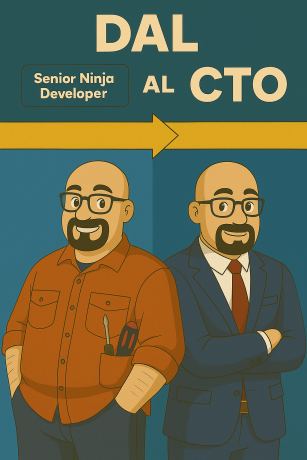
Everyone loves to describe the transition from Senior Developer to CTO as a natural evolution.
Visionary leadership, strategy, innovation, long-term vision.
Elegant, reassuring words that ignore the uncomfortable truth: when you become a CTO, you stop doing the job you spent years mastering.
It’s not a promotion.
It’s a career change.
And almost no one prepares you for this shock.
The identity shock: you’re no longer valued for the code you write
As a Senior Developer, you’re used to being measured by the quality of your code.
As a CTO, you are measured by something completely different: how you make others work.
It’s a professional grief, because you must accept that:
- you’re no longer “the one who solves technical problems”
- you can no longer prove your value by writing better code than everyone else
- you can’t spend two hours optimizing an algorithm just for personal satisfaction
Your new role is to be a capacity multiplier, not a direct producer.
And that shift is traumatic.
The part no one tells you about: the CTO is an unpaid psychologist
Everyone talks to you about strategy.
Then you step into the role and discover that 40% of your time is dedicated to other people’s emotions:
- managing burnout and anxiety
- mediating conflicts swept under the rug
- giving feedback no one wants to hear
- preventing a toxic senior from driving away the best juniors
- reading silence and noticing when someone is about to quit
It’s the most invisible and exhausting part of the job.
And it’s completely new for anyone coming from coding.
Goodbye certainty, welcome ambiguity
Code is binary.
The CTO role is not.
Every decision is a bet.
You make choices with incomplete information, on topics that can’t be measured:
people, strategy, budgets, internal politics.
There is no longer the pleasure of certainty.
Only the responsibility of doubt.
The loneliness of the role: everyone wants answers, no one wants to see your doubts
Here’s one of the heaviest parts no one talks about:
decision-making loneliness.
You can’t ask developers for help.
You can’t ask the CEO for technical guidance.
You can’t say “I don’t know.”
When you make a mistake, it’s your fault.
When things go well, it’s the company’s merit.
It’s the role with the highest mental load, yet the least understood.
The team’s perceived “betrayal”
The moment you cross the line, everything changes.
From “one of us” you become “one of them.”
Every word gets filtered as if it were politics.
Every piece of feedback feels like control.
Every technical opinion looks like interference.
And you find yourself balancing between:
- not micromanaging
- staying technical
- keeping credibility
- giving space to leads and seniors
It’s a constant exercise, far more fragile than it seems.
The hardest part: managing humans, not systems
You can optimize a system.
You cannot optimize a person.
As a CTO you must learn to:
- hire well
- fire when necessary
- build growth paths
- recognize talent
- identify harmful behaviors
- protect the team from external interference
- protect the company from internal egos
This is the part of the job farthest from coding, and the one that determines whether a CTO builds strong teams or collapses.
Goodbye deep work: your time is no longer your own
As a Senior you can spend 4–6 hours a day in deep work.
As a CTO, you are the most interrupted person in the company.
- meetings
- syncs
- emergencies
- unexpected issues
- quick decisions
- people knocking at your (physical or digital) door
- calls with the CEO, clients, partners, investors
Your superpower is no longer focus.
It’s instant prioritization.
The collapse of perceived productivity
When you become CTO, it feels like you “do nothing.”
You don’t write code.
You don’t close tickets.
You don’t commit anything.
But your value is no longer tangible.
It’s social, systemic, organizational.
You stopped being a producer.
You became a multiplier.
The anxiety of losing your technical edge
And then there’s the technical impostor syndrome.
As a CTO, your time to study drops dramatically.
The team runs, technologies evolve, but you… don’t.
This creates:
- anxiety
- insecurity
- fear of being overtaken
- fear of making decisions that no longer feel “solid”
It’s normal.
But no one says it out loud.
The final truth: it’s not a promotion, it’s a new profession
Many excellent Seniors become terrible CTOs.
Not because they’re not good — but because they refuse to accept the truth:
being a CTO is not the next level of being a Senior Developer.
It’s an entirely different job.
It requires:
- human skills
- conflict management
- real delegation
- systemic vision
- tolerance for ambiguity
- emotional responsibility
It’s not an upgrade to coding.
It’s a career change.
Conclusion
If you’re thinking about becoming a CTO, inform yourself carefully.
Don’t get fooled by elegant words.
It’s not a role for someone who wants to keep being a Senior with more power.
It’s a role for those willing to shed their skin.
And to do it by facing the least glamorous part of technology:
people.