 Valerio's Cave
Technical documentation: a journey, not a recipe
Technical documentation: a journey, not a recipe
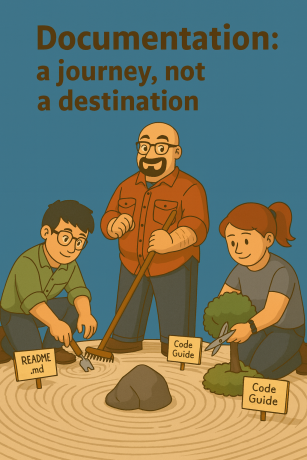
Technical documentation is not a static object, nor a manual you write once and then forget.
It’s a journey: it evolves, changes shape, and adapts to the people who need to use it.
In my company, I’ve realized that the real challenge isn’t “writing”, but making documentation part of the workflow, instead of a forgotten archive.
What follows is not an infallible method, but a set of attempts and practices that over the years have helped me and the teams I’ve worked with turn documentation into real support — not an annoyance.
Keeping documentation organized
Messy documentation discourages consultation. The first step is giving it a recognizable, simple, and consistent structure.
Clear hierarchy
The structure must be logical:
- thematic macro-areas
- pages with a clear purpose
- no duplicates
A concise page that goes straight to the point is better than two pages that say almost the same thing.
Every page must answer a question
I always ask myself:
“Who is this page for, and why does it exist?”
If I don’t have a clear answer, the page is unnecessary.
Paths, not just pages
A team doesn’t only need content: it needs a path.
Examples:
- onboarding path
- troubleshooting path
- path dedicated to junior developers
- path for critical processes
The difference between “there are many pages” and “I know where to go” is huge.
Who should write it, and how
Documentation is a collective effort, but it requires a culture that empowers everyone to contribute.
Whoever changes → documents
It’s not a new concept, but it only works when it becomes part of the flow:
- whoever implements something updates the documentation
- whoever fixes a bug updates the relevant section
- whoever defines a process documents it
Documentation shouldn’t be an “extra activity”.
It’s part of the job.
Writing in a readable way
Simple, direct, human style:
- short sentences
- concrete examples
- clean snippets
- no unnecessary jargon
- conversational tone
The goal isn’t “to write a beautiful document”:
it’s to help someone understand something in the shortest possible time.
Repeatable structure
A standard format helps both the reader and the writer:
- Prerequisites
- Steps
- Expected result
- Common issues
After just a few pages, the team recognizes the structure and reads more efficiently.
How to keep it up-to-date
Any documentation, if not maintained, ages faster than code.
Periodic reviews
Each area should have a scheduled review: quarterly if critical, semi-annual if stable.
You don’t need to read everything: just verify that what’s there is still true.
Repeated questions are an alarm bell
When I’m asked the same thing three times, I no longer think:
“This person didn’t read.”
I think:
“The documentation on this topic doesn’t work.”
Repetition is valuable feedback.
Removing is more important than adding
Real updates often mean removing:
- cutting obsolete sections
- shortening overly long explanations
- eliminating duplicates
- consolidating similar pages
Shorter documentation is almost always better documentation.
Gamification techniques
When used correctly, gamification boosts participation.
It shouldn’t be childish or forced: it should make documentation a “serious but light” kind of game.
Badges and acknowledgments
Publicly acknowledging contributors works better than most people imagine:
- “Contributor of the month”
- “Most useful page”
- “Latest release reviewer”
Internal micro-challenges
Small monthly challenges can increase attention:
- “Update an outdated page”
- “Find and fix an error”
- “Complete a path by reading 3 critical pages”
Counters and statistics
Simple metrics such as:
- how many pages were updated
- which sections are most consulted
- which pages generate the most questions
make the value of the work visible.
Using AI as reviewer and copilot
AI doesn’t replace documentation, but it can dramatically improve the way it is produced and maintained.
AI as reviewer
It can detect:
- inconsistencies
- overly complex sections
- non-uniform terminology
- ambiguous passages
It’s like having a tireless and impartial reviewer.
AI as writing copilot
AI is extremely useful for:
- generating drafts
- rewriting unclear paragraphs
- suggesting titles and structure
- producing examples, snippets, and tables
The greatest value?
It speeds up production while maintaining consistency.
AI as consultation assistant
Team members no longer need to “look for” a page: they can ask a question.
AI directs them to the right section and reduces friction in daily use.
Conclusion
Documentation is not a finished project and it’s never perfect.
It is part of the system, and like every part of the system:
- it evolves
- it simplifies
- it updates
- it adapts to the people who use it
There is no universal recipe, only a journey made of maintenance, structure, shared contributions, and smart tools.
The goal is not “to write a lot of documentation”.
The goal is to create an environment where the team can find and understand what they need effortlessly — and that truly changes the way we work.