 Valerio's Cave
Giving Technical Feedback Without Destroying Motivation and Autonomy
Giving Technical Feedback Without Destroying Motivation and Autonomy
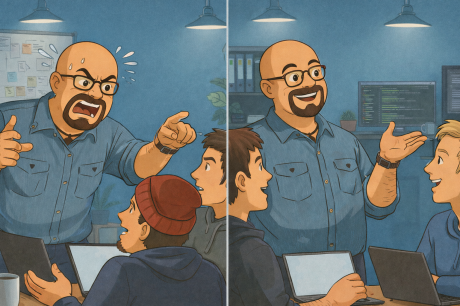
In the technical world, feedback is a double-edged sword. It is essential to improve code quality, systems, and decision-making, but when delivered poorly it can destroy motivation, autonomy, and trust in a very short time.
The paradox is that the most competent people are often the most fragile when it comes to feedback: their personal value is deeply intertwined with what they produce.
This article is the result of years of code reviews, retrospectives, my own mistakes and those of others, and a conviction shaped over time:
Technical feedback is not a corrective act, but an act of leadership.
Why technical feedback creates resistance
Resistance to change is often labeled as an individual problem. In reality, it is a physiological response.
When we receive technical feedback perceived as a threat:
- the brain switches to defensive mode
- attention shifts from the problem to ego protection
- autonomy is perceived as being at risk
This is not a matter of maturity, but of psychological safety.
If we want to reduce resistance, we must first understand that:
- we are not just talking about code
- we are talking about professional identity
Radically separating the person from the code
One of the simplest and hardest rules to apply:
We review code, not people.
Feedback should always refer to:
- observable behaviors
- measurable technical effects
- concrete risks
Never to:
- presumed intentions
- personal abilities
- implicit judgments about the author
Code is negotiable. Self-esteem is not.
Providing context before judgment
Many technical feedback conversations fail because they lack context.
Saying that something “is not good” is not enough. It is essential to explain:
- why it is a problem
- in which scenario it becomes critical
- which system-level objective we are protecting
Scalability, maintainability, resilience, operational risk: when feedback is anchored to these elements, it stops sounding like an opinion and becomes a shared evaluation.
Feedback as a hypothesis, not a verdict
Language changes everything.
Feedback framed as a verdict shuts down the conversation. Feedback framed as a hypothesis opens it.
Examples:
- What happens if this service scales 10x?
- Have you considered the impact on recovery time?
- I’m concerned about this point in case of partial failure
This approach turns feedback into co-design, not hierarchical correction.
Turning friction into growth
Technical friction is inevitable. Disagreement, when handled well, is a sign of a healthy team.
The problem is not conflict itself, but how it is channeled.
When dissent is normalized:
- change is no longer perceived as an imposition
- ideas circulate before they crystallize
- decision quality improves
A team that does not argue is not aligned: it is silenced.
Analyzing errors without looking for culprits
Every technical error is a missed opportunity if it is treated as individual blame.
The right question is not:
Who made the mistake?
But:
Why did the system allow this error?
Recurring patterns often emerge:
- superficial reviews
- ambiguous requirements
- lack of checklists or guardrails
- unspoken time pressure
Here, feedback becomes organizational architecture, not just technical critique.
From error to case study
One of the most powerful ways to preserve autonomy and motivation is turning errors into case studies.
Not as top-down lessons, but as:
- guided retrospectives
- lightweight documentation
- reusable examples
The implicit message is crucial: I don’t control you. I give you tools.
In this way, individual experience becomes collective knowledge.
The role of the technical leader
Those who lead technical teams are not there to prove they are always right. They are there to:
- create context
- facilitate better decisions
- enable others to be autonomous
Giving effective feedback means:
- choosing the right timing
- separating technical feedback from emotional feedback
- always closing with a clear direction
Feedback without direction generates frustration, not growth.
Conclusion
Technical quality does not come from control, but from safety. Autonomy does not come from the absence of feedback, but from trust in how it is delivered.
If feedback destroys motivation, it is not feedback: it is power disguised as guidance.
And in the long run, power does not scale. Trust does.