 Valerio's Cave
Incident Analysis: How to Turn a Disaster into a Team Accelerator
Incident Analysis: How to Turn a Disaster into a Team Accelerator
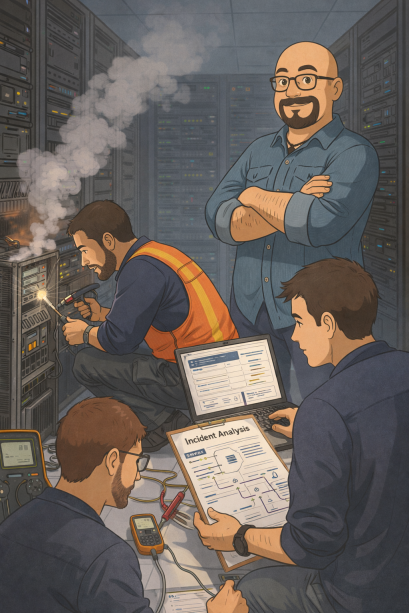
Incidents don’t destroy teams.
The way we react does.
In complex systems — distributed software, cloud infrastructures, third-party integrations, high-volume logistics — incidents are not exceptions. They are structural variables.
The difference between a mediocre team and a mature one is not the absence of problems.
It is the quality of the response.
Over the years, I’ve learned that an incident can become a cultural, technical, and organizational accelerator. But only if handled with clarity and composure.
The Incident Is Not the Problem
Complex systems fail.
External dependencies break.
Misconfigurations slip through controls.
Traffic exceeds forecasts.
Human error is rarely the primary cause. It is often the symptom of:
- incomplete processes
- insufficient monitoring
- unclear ownership
- fragile systems
- lack of redundancy
If the first question is “Who did it?”, we have already wasted an opportunity.
The right question is:
“What part of the system allowed this to happen?”
The First Mistake: Reacting Emotionally
During an incident, the team observes everything:
- tone of voice
- speed of decisions
- level of anxiety
- communication style
The leader is the emotional regulator of the system.
If they panic → they amplify chaos.
If they look for someone to blame → they block transparency.
If they take over everything → they create dependency.
The instinctive reaction is to jump in immediately, fix it, demonstrate control.
The effective reaction is different:
stabilize before solving.
Pause Before Acting
The early stages of an incident should be methodical:
- Define the scope of the problem.
- Separate facts from interpretations.
- Establish an incident commander.
- Assign clear roles.
- Centralize communication.
What’s needed is not more energy.
It’s more structure.
A team under pressure without structure generates noise.
A team with clear roles generates solutions.
Analyze Coldly, as a Team
The real transformation happens during the post-mortem.
An effective Incident Analysis includes:
- An objective timeline of events
- Verifiable data
- Technical reconstruction without judgment
- Systemic analysis (not personal)
- Identification of root causes
Useful tools:
- 5 Whys
- Cause-and-effect diagrams
- Log and metrics review
- Single Point of Failure (SPOF) analysis
The fundamental rule:
facts, not opinions.
Blameless ≠ No Accountability
Blameless does not mean “everything is fine.”
It means:
- no personal attacks
- no public humiliation
- no culture of fear
But it also means:
- clear accountability for action items
- defined owners
- deadlines
- verifiable follow-up
A blameless culture increases transparency.
Transparency increases learning speed.
Resist the Temptation of Heroism
Every technical leader knows the temptation:
“I’ll handle it.”
In the short term, it’s efficient.
In the medium term, it’s destructive.
If the CTO always intervenes:
- the team doesn’t build antibodies
- dependency increases
- a single point of failure is reinforced
- the organization remains fragile
Individual heroism is the opposite of scalability.
A mature team must be able to handle incidents even without its leader on the front line.
The role of a leader is not to save the day.
It is to build a system that can save itself.
Every Incident Must Leave a Legacy
If everything remains the same after an incident, we have only suffered unnecessarily.
Every incident should produce:
- new automated tests
- improved monitoring
- smarter alerts
- updated playbooks
- clearer documentation
- more robust processes
An incident without improvement is a cost.
An incident with improvement is an investment.
The Incident as a Cultural Crash Test
An incident is an organizational crash test.
It reveals:
- the quality of communication
- the level of trust
- technical maturity
- clarity of roles
- system resilience
Under pressure, cracks that are invisible in normal conditions emerge.
And that is a good thing.
Because what becomes visible can be improved.
The Real Accelerator: Trust
When a team knows that:
- it can report a mistake without fear
- it will be heard without judgment
- the analysis will be systemic, not personal
- the goal is improvement, not punishment
Something powerful happens.
People begin to:
- report issues earlier
- be more transparent
- propose improvements
- take ownership
Trust reduces detection time.
It reduces resolution time.
It reduces the probability of recurrence.
Conclusion
A company is not measured when everything works.
It is measured when something breaks.
Incidents are inevitable.
Mediocrity is optional.
A leader can use an incident to:
- exercise control
- distribute blame
- demonstrate technical superiority
Or they can use it to:
- strengthen the team
- improve the system
- build trust
- increase organizational maturity
The difference is not technical.
It is cultural.
And that is where scalable organizations are built.