 Valerio's Cave
From Maintenance to Product
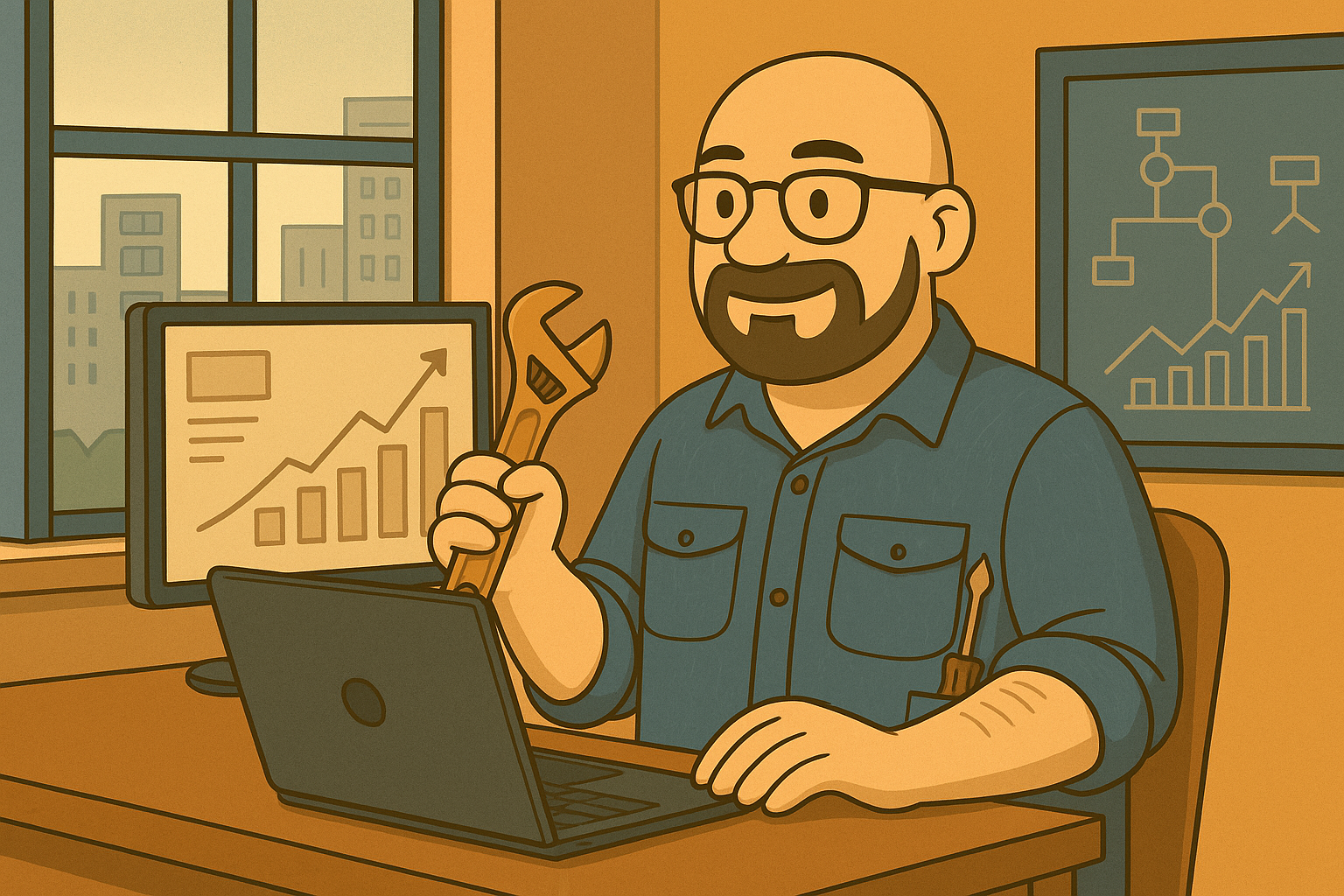
From Maintenance to Product: the mindset shift that saved my career
When you spend every day immersed in code, processes, systems, and urgent requests, you risk losing sight of a key truth: maintenance keeps the present alive, but only vision builds the future.
For years, I thought that “keeping everything running” was enough. Until I realized I was keeping myself stuck as well.
This article comes from that very mental shift that changed the way I work, lead teams, and look at technology: no longer as an endless series of interventions, but as a living product that grows.
Don’t underestimate maintenance work, but don’t make it your horizon
Maintenance is essential. It’s what allows customers to use the product, what keeps the company from putting out daily fires, and what provides the team with a stable reference point.
In fact, people who do maintenance learn more than they realize:
- They know the system better than most.
- They have a real pulse on recurring issues.
- They see where past decisions limit the present.
But there’s an invisible limit: if your professional identity becomes “the one who fixes things,” you stop growing.
And when you stop growing, the tech world moves on without you.
Why improving the product matters
Improvement is not a whim—it’s survival.
Any product that remains still dies slowly, often before anyone notices.
The effects show up in three areas:
- Technical: increasing debt, compounding complexity, decisions that become slow and difficult.
- Business: customers start looking elsewhere, competitors innovate while you consolidate.
- People: teams lose motivation, professionals feel trapped in an endless maintenance loop.
It’s not about chasing the shiniest feature or reinventing everything, but about embracing a simple idea: every now and then, the product must be looked at with fresh eyes.
When technical debt suffocates innovation
There’s an aspect you often understand only after years inside real systems: you can’t always innovate when you want to.
Sometimes technical debt is so wide and deep that moving forward becomes risky. Every attempt to introduce something new becomes an acrobatic effort—a patchwork of compromises that moves you one meter forward and two meters back.
This is where some of the most mature lessons of our craft emerge:
Not everything can be innovated right away.
You need clarity to recognize when the system can’t handle further changes without first being stabilized.Technical debt is not a monster to eradicate, but a story to understand.
It’s the result of past priorities, not a moral failure of the team.Sometimes real innovation is invisible.
It might be a boring refactoring, an unglamorous rewrite, or a cleaned-up process. These are investments that don’t shine today, but enable tomorrow’s growth.Knowing how to wait is a skill, not a weakness.
Waiting doesn’t mean delaying out of fear; it means recognizing that forcing innovation at the wrong time can compromise years of work.
In this delicate balance lies something valuable:
innovation isn’t only about adding—it’s about preparing the ground so innovation can truly happen.
How to navigate both paths
Maintenance and innovation shouldn’t be two competing boxes fighting for attention.
It works much better when they become two streams that reinforce each other.
Here’s what I’ve found effective:
- Maintenance as a source of insight: every bug tells a story, every slowdown signals a weak point.
- Improvement as a discipline, not an occasional project: small, steady steps—not sporadic revolutions.
- Protected time for the team: even half an hour a week creates momentum if respected.
- Priorities based on overall value: not just features, not just fixes—whatever truly moves the product forward.
The key is not choosing one path, but avoiding being trapped in only one.
What to learn
This mindset shift brings several lessons:
- Your job isn’t just doing—it’s observing.
- Maintenance is a compass, not a destination.
- Value isn’t in the lines of code, but in the direction you give the product.
- Growth is the result of vision and patience, not frantic sprints.
Thinking in terms of product forces you to look farther and build with greater responsibility.
What you gain
This mindset shift doesn’t just improve the product—it improves the people working on it.
Here are the tangible benefits:
- Greater motivation: working on something that evolves is far more energizing.
- A stronger perception of your role: you become a builder, not just a maintainer.
- Healthier relationships with stakeholders and customers: you talk about vision, not just problems.
- Natural professional growth: you start proposing solutions, not merely reacting.
- A more resilient career: those who can evolve a product are always in demand.
Conclusion
Moving from a maintenance mindset to a product mindset doesn’t mean stopping fixing things—it means giving a different meaning to how you do them.
Vision creates movement. Movement creates growth.
And growth—both personal and professional—is the only antidote to stagnation.
If this shift saved my career, it’s because it helped me understand something simple:
it’s not enough to make a system work… you must make it progress.