 Valerio's Cave
When I Realized I Had Become a Micromanager
When I Realized I Had Become a Micromanager (and Why It Became My Turning Point)
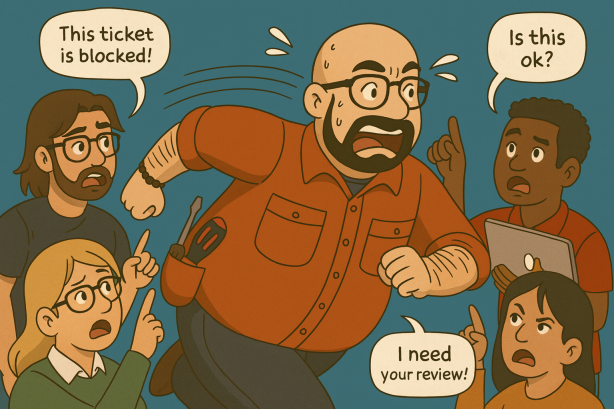
I remember the scene perfectly.
It was a regular Thursday morning, one of those days when your calendar is just a list of fires to put out and the coffee is never enough.
My team was working on a new integration and we had a tight deadline to meet.
I was on a call, headset half crooked, one hand on the keyboard, rereading a PR for the third time—the same one I had already corrected five days earlier.
At some point one of my developers wrote in our internal channel:
“Valerio, I’ve updated the function again. But if it’s not how you want it, tell me and I’ll fix it once more.”
I read that sentence twice.
Then three times.
And it hit me like a punch in the stomach: the problem wasn’t the function — it was me.
Micromanagement doesn’t show up all at once. It slowly slips in.
It doesn’t start with “I want to control everything.”
It begins with small gestures that even look virtuous:
- “Let me see, I’ll fix it in a second.”
- “No, wait, I’ll rewrite this — it’s faster if I do it.”
- “Before closing the task, let me check it.”
At first you do it to help.
Then you do it to control.
Then you don’t know how to stop.
In my case, I thought I was doing it to “maintain quality,” but the truth was much simpler and much less noble:
I didn’t trust the system enough, so I ended up replacing people instead of guiding them.
The day I realized I was taking away responsibility, not ensuring quality
That sentence — “tell me how you want it to be” — made me realize I had created an environment where the team no longer proposed ideas but asked for permission.
And when a team starts asking for permission, the leader has already become a bottleneck.
I noticed that:
- nobody made decisions without checking with me
- tickets moved through the workflow with me glued to every step
- PRs were shaped according to my style, not the company’s
- any creative divergence was shut down at the source
And while the team was losing autonomy, I was losing energy.
The perfect paradox: working more to achieve less.
The real engine of micromanagement is fear (and we rarely admit it)
We tell ourselves it’s “attention to detail.”
That it’s “ensuring quality.”
That it’s “protecting the outcome.”
But the truth is, it’s often fear:
- fear that an error might fall back on us
- fear of losing control
- fear that the team might shine without us
- fear that our value becomes less visible if we don’t supervise everything
My fear?
That something would slip through and someone would ask me: “Where were you?”
I was everywhere.
Too much.
Getting out of micromanagement isn’t a switch — it’s continuous training
One thing I wish I had known from the beginning is that micromanagement doesn’t turn off.
It’s not a habit you drop over a weekend. It’s more like a posture:
stop paying attention to it, and you fall back into it.
I’m still on that journey.
Not because I didn’t learn the lesson, but because people don’t absorb change at the same speed as the one who leads it.
When you start delegating, the team often:
- still waits for your approval, out of habit
- is afraid to make mistakes, because for months (or years) the message was: “ask me first”
- keeps looking to you as the technical reference, even when it’s not needed
- struggles to trust the new balance, especially if the previous culture was different
And that’s when I understood something essential:
Breaking free from micromanagement doesn’t just mean changing your behavior.
It means supporting the team while they adapt to a new way of working.
It requires patience.
It requires consistency.
And it requires accepting that, under pressure, the temptation to “do everything myself” comes back strong.
Sometimes I still fall into it.
The difference is that now I notice it immediately.
And I put my hands back where they belong: not on other people’s work, but on my own leadership.
The turning point: learning to let go without leaving people alone
Starting over doesn’t mean abandoning the team.
It means stopping doing things for them, and starting to create the conditions where they can succeed.
I began defining outcomes, not instructions.
No more: “Do it like this.”
But: “This is the goal, this is the context, these are the boundaries. The how is up to you.”
And something surprising happened:
people started making mistakes again.
And it was wonderful.
Because every mistake was:
- real feedback
- an opportunity to improve the process
- a chance for someone to grow
- a piece of autonomy returning to its rightful place
And as the team grew, I became a better leader.
Not because I controlled everything, but because I finally focused on what only I could do:
vision, strategy, removing roadblocks, enabling people.
The lesson I wish I had learned years earlier
Micromanagement isn’t a personality flaw.
It’s a symptom.
A signal that something is missing:
- clarity
- trust
- solid processes
- authentic communication
- courage to delegate for real
And above all, it’s a signal that the leader is using control in place of culture.
Control reassures.
Culture empowers.
And a company grows only with the latter.
Conclusion: trust is the most technical move a leader can make
Today I look at that sentence from my developer with gratitude.
It showed me the hidden side of my role: my shadow.
Every time I’m tempted to “put my hands on things,” I ask myself:
am I leading or am I controlling?
If the answer is the latter, I stop.
I breathe. I listen. I delegate.
And I make space for the team to do what they were hired to do:
create value, not mirror my way of working.
If this story resonates with you, you’re probably already on the right path — the one where the leader grows with the team, not above it.