 Valerio's Cave
Antifragile Teams
How to Build Antifragile Teams in Digital Chaos
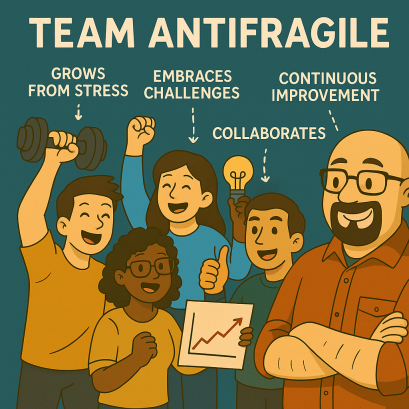
In a tech context made of tight deadlines, continuous releases, production incidents, and roadmaps that change every three sprints, the real difference is not made by the “perfect team” but by the team that absorbs shocks, learns fast, and comes back every time a bit stronger.
This article aims to present a resilient and modern managerial vision, where the role of the CTO and team leaders is not to eliminate errors, but to design human and organizational systems that can metabolize them.
Using Errors as Fuel
An antifragile team doesn’t avoid errors: it uses them to improve.
Most organizations pour energy into trying to reduce errors to zero: more processes, more control, more bureaucracy.
The result? Paralyzed teams, fear of speaking up, zero creativity.
The antifragile approach is different:
- Error is not a personal failure, but a system signal.
- The goal is not to avoid incidents, but to reduce their impact and use them to improve architectures, processes, and skills.
- Every crisis becomes a team “upgrade”, not a trauma to be swept under the rug.
In a digital world that changes faster than our processes, the one who adapts fastest wins, not the one who makes the fewest mistakes.
What Antifragility Means in a Tech Context
Resilience is the ability to return to the initial state after a shock.
Antifragility, instead, is the ability to get better thanks to the shock.
In a tech context, an antifragile team is a team that:
- Doesn’t collapse under pressure when:
- a deploy goes wrong,
- an enterprise customer is yelling on the phone,
- an urgent request arrives from the sales department.
- Doesn’t just “put out fires”, but turns each incident into:
- a technical lesson (new best practices, refactoring, automations),
- an organizational lesson (how we communicate, who decides what).
- Accepts that complexity is not fully controllable:
- distributed systems,
- external dependencies,
- business constraints,
- people with different skills and personalities.
In practice, an antifragile team:
- Has room to maneuver (technical autonomy).
- Has psychological safety (you can talk about problems without a witch hunt).
- Has sustainable rhythms (it doesn’t live only in “emergency mode”).
How to Handle Pressure and Uncertainty
Pressure and uncertainty are the “normal climate” in digital. The point is not to eliminate them, but to learn how to handle them in a healthy way.
Normalizing Uncertainty
A classic management mistake is selling the team the illusion of control:
- roadmaps “set in stone” for 12 months,
- absolute promises to customers,
- hyper-detailed planning in highly variable contexts.
An antifragile approach starts from more honest communication:
- “Priorities may change in 2 months.”
- “This is the direction, not a contract signed in blood.”
- “It’s normal not to have all the answers right now.”
When uncertainty is made explicit, the team stops experiencing it as a personal failure and starts treating it as a project variable.
Protecting the Fundamentals: Energy, Focus, Time
A team under constant pressure doesn’t become antifragile; it becomes worn out.
Pressure can be managed, but you need to work on the fundamentals:
WIP limit (work in progress limit)
Avoid having people working on 5 tasks at the same time. Less multitasking, more depth.Protected focus slots
Time windows where:- no calls,
- no “urgent” messages,
- no expectation of immediate reply.
Sustainable work pace
If you work in “crunch mode” for weeks, that’s not an antifragile team; it’s a team in pre-burnout.
Turning Conflict into Constructive Confrontation
Pressure often brings out conflicts. In a fragile team, conflict becomes:
- personal clashes,
- blame-shifting,
- passive-aggressive silence.
In an antifragile team, conflict is:
- explicit but respectful (“I disagree for these reasons…”),
- focused on the problem, not the person,
- moderated by the leader, who facilitates the discussion rather than shutting it down.
The Role of the CTO as a “Shield”
In a digital organization, the CTO isn’t just the “head of the techies”: they are the shield between external chaos and the team.
Filtering Noise, Not Information
Being a shield doesn’t mean locking the team in a bubble, but filtering and structuring chaos:
- Translating vague requests into clear, prioritized tasks.
- Protecting the team from:
- customers’ emotional escalations,
- impulsive decisions from upper management,
- sales promises made “without checking first”.
The CTO must ensure that the team works with a level of noise compatible with deep thinking.
Publicly Owning Responsibility for Errors
When something goes wrong:
- with the board,
- with customers,
- with other departments,
an antifragile CTO:
- steps in front: “The responsibility is mine, not that of a single developer.”
- avoids public shaming of team members,
- handles any “tough” feedback in private, with maturity.
Inside the team, instead:
- the incident is analyzed in a technical and calm way,
- the work focuses on:
- what we learned,
- what we change starting tomorrow.
This creates a powerful effect: people dare to talk about problems, instead of hiding them.
Caring for Both Architecture and Relationships
A CTO who only cares about architecture builds systems that look good on paper, but fragile teams.
A CTO who only cares about people risks ignoring the technical consequences of decisions.
Antifragility requires both dimensions:
- Technical:
- automate wherever possible,
- minimize the blast radius of each error,
- design architectures that degrade in a controlled way.
- Human:
- give calibrated, useful feedback,
- recognize achievements,
- address conflicts before they fester.
Tools and Rituals of Resilience
An antifragile team doesn’t come from “nice speeches” alone: it’s built through concrete, repeated practices.
Blameless Incidents and Post-mortems
Every significant incident should generate:
- a concise incident report (what happened, impact, timeline),
- a structured post-mortem.
The golden rule: no blame.
In the post-mortem, you talk about:
- missing or fragile processes,
- weak points in the architecture,
- lack of automation,
- communication issues.
And you always come out with:
- max 3 concrete actions to put in the backlog (not 30 vague promises),
- a clear owner for each,
- a realistic deadline.
The goal is not “finding who’s at fault”, but strengthening the system.
Regular Alignment Rituals
Resilience is also built through simple but consistent rituals:
Short and honest dailies/stand-ups
- Not a show about “who is most productive”.
- But a space to bring up blockers, risks, and dependencies.
Regular retrospectives
- Not only about “what didn’t work this sprint”.
- But also about:
- how we are handling pressure,
- which team dynamics are hurting us,
- what we want to change in how we collaborate.
Regular 1:1s
- A safe space to:
- share personal difficulties,
- give feedback upwards to the leader,
- intercept early signs of burnout or demotivation.
- A safe space to:
Tools That Reduce the Cost of Error
The cheaper it is to experiment, the more antifragile the team becomes:
- Feature flags and canary releases
- An error only affects a small portion of users.
- Realistic staging environments
- You can test complex scenarios without fear of “breaking everything”.
- Serious logging, monitoring, and alerting
- If you can’t see problems, you can’t learn from them.
- Automation of toil
- Everything repetitive and manual under stress should be automated: it reduces human error and frees mental energy.
Conclusion: Building a Feedback Culture
At the core of an antifragile team there is a culture where feedback is not an exception, but part of the daily flow.
Continuous Feedback, Not Just in “Emergency Mode”
A feedback culture means:
- saying “this doesn’t work” before it explodes,
- explicitly recognizing when something works well,
- treating problems as objects on the table, not personal accusations.
Feedback becomes:
- bidirectional (from leader to team and from team to leader),
- specific (not “you’re good/bad”, but “this choice had this impact”),
- frequent (not just in annual performance reviews).
From Control to Trust
An antifragile team cannot be managed through micromanagement:
- controlling every decision,
- demanding constant reporting on every detail,
- blocking every move until someone “higher up” approves it.
Instead, it requires:
- trust in technical autonomy,
- strong alignment on goals,
- radical transparency about constraints, risks, and priorities.
When people feel they can experiment without being destroyed by a mistake, they start to:
- propose improvements,
- anticipate problems,
- take real ownership.
In Summary
Building antifragile teams in digital chaos means accepting that:
- errors will always exist, but we can reduce their impact and maximize learning from them;
- the role of the CTO and leaders is not to keep everyone “in line”, but to create the conditions for the team to grow stronger after every shock;
- tools (monitoring, automation, processes) matter, but without psychological safety and a feedback culture they are just a fresh coat of paint.
There is no modern tech organization without chaos.
The real choice is whether to suffer it… or use it to become stronger.