 Valerio's Cave
Why Teams Become Slow (and How to Unblock Them in Real Situations)
Why Teams Become Slow (and How to Unblock Them in Real Situations)
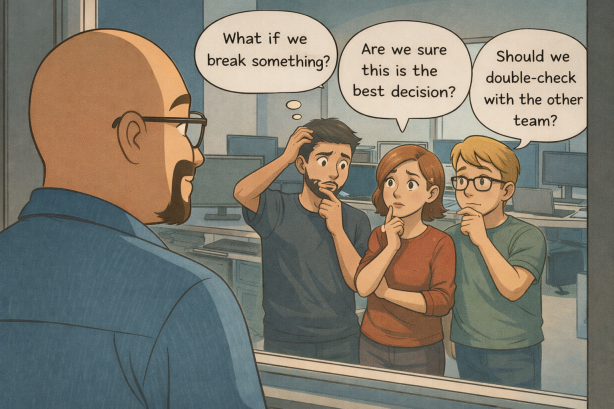
It almost always happens the same way.
At the beginning, the team is fast.
Decisions come quickly.
Features get shipped.
Retrospectives are full of ideas.
Then, slowly, something changes.
Pull requests stay open longer.
Decisions get postponed.
Meetings become more frequent but less useful.
And every task seems to take twice as long.
The team hasn’t become less competent.
And the problem is almost never technical.
The problem is psychological.
The Typical Situation
Imagine this scenario.
The team needs to release an important new feature.
Several services are involved, there are some external dependencies, and a bit of technical debt.
The team starts working on it.
Then the first signals appear:
- someone says: “let’s wait until the requirements are clearer”
- someone else suggests: “maybe we should refactor this part first”
- another person adds: “perhaps we should involve team X as well”
Within a few days something curious happens:
everyone is working,
but nothing seems to really move forward.
This is the classic operational stall disguised as prudence.
What Is Really Happening (Psychologically)
When a team slows down, it’s rarely because technical capability is missing.
It’s because the perceived risk increases.
People start thinking:
- “What if I make a mistake?”
- “What if I break something?”
- “What if this turns out to be the wrong decision?”
When perceived risk increases, something very predictable happens:
the team starts seeking protection in collective decisions.
So:
- meetings multiply
- decisions are shared among more people
- tasks get broken down more and more
- no one wants to be the first to move
This is a very human mechanism.
Distributed responsibility reduces anxiety.
But it dramatically slows down the system.
The Lever That Actually Unblocks Teams
The temptation for many managers is to increase control.
More meetings.
More reporting.
More alignment.
That is exactly the opposite of what is needed.
The lever that actually works is much simpler:
reduce the perceived cost of making mistakes.
When a team knows that:
- mistakes are recoverable
- decisions can be corrected
- no one will be “punished” for trying
something interesting happens:
people start making decisions again.
And when people make decisions, the system starts moving again.
For leaders, this means doing three very concrete things:
Reduce the size of decisions
Ten small decisions today are better than one perfect decision in two weeks.Make decision ownership explicit
Ambiguity in responsibility leads to paralysis.Protect people who take initiative
If decision-makers are publicly criticized, nobody will decide anymore.
A Small Truth That Makes You Smile
Most teams are not slow.
They are terrified of doing the wrong thing in front of the wrong people.
And if you think about it, that’s exactly what happens to adults in meetings too.
We just use more sophisticated words to hide it.
The Real Job of Someone Leading a Team
A fast team is not the one with the most brilliant developers.
It is the one where:
- decisions are clear
- mistakes are inexpensive
- responsibility is explicit
In other words:
it’s not the speed of the people that matters.
It’s the friction in the system.
And much of that friction remains invisible, until someone decides to remove it.