 Valerio's Cave
Aligning the Technical Team with Business Goals: A Practical (and Honest) Guide
Aligning the Technical Team with Business Goals: A Practical (and Honest) Guide
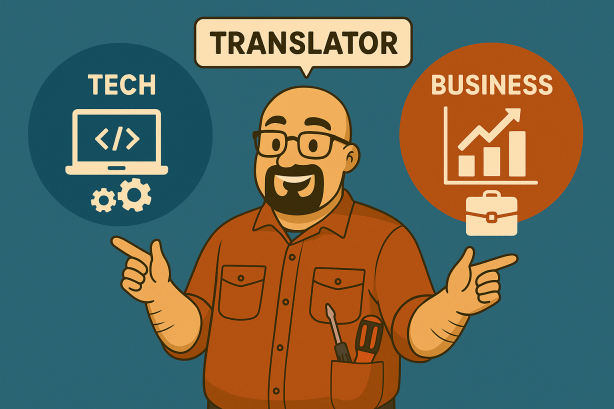
Aligning the technical team with business goals is one of the most delicate, frustrating, and strategic responsibilities for anyone leading engineering.
This isn’t a theoretical topic: it’s a daily struggle.
It’s the recurring doubt of every CTO and Engineering Manager: “Am I communicating the right way? Am I truly conveying the urgency or importance of things?”
Even I, after years of technical leadership, often feel like I still haven’t found the perfect formula.
In this article, I want to share practical reflections, recurring mistakes, and real techniques that can help bridge the gap between what the business wants and what the technical team perceives.
The Natural Bias of Technical Teams: Thinking About Work, Not Strategy
The first point to accept is this: technical teams do not naturally think in business terms, and not because they don’t want to — but because that’s not their job.
Engineers are trained (and passionate about):
- writing better code,
- reducing complexity,
- architecting elegant solutions,
- avoiding technical risks.
Strategy and business goals are often perceived as a separate universe, typically belonging to product, marketing, or the board.
This creates a natural bias:
“I do my job. Strategy is someone else’s problem.”
Your role here is to build the bridge between these two worlds.
The Natural Conflict Between Technical and Business Vision
This conflict is not anyone’s fault.
It’s intrinsic, physiological, almost inevitable.
- Engineers want quality, stability, and time to do things properly.
- The business wants speed, flexibility, and time-to-market.
These two vectors may seem opposite, but in reality they move in the same direction: creating value.
Someone needs to synchronize them. That someone is you.
The CTO as a “Simultaneous Translator”
Being a CTO today doesn’t just mean making architectural decisions.
It means translating abstract business goals into concrete engineering problems.
Examples of translation:
From: “We need to increase Q4 sales”
To: “We need 3 features that reduce churn in these customer segments.”From: “The board wants to push international expansion”
To: “We need to make the system multilingual and localizable within 60 days.”
These translations make the link between technical work and business outcomes explicit.
Giving Visibility to Numbers (The Tech Team’s Favorite Language)
If you want to change the team’s behavior, show them the numbers.
Powerful examples to include:
- How much revenue is lost each day if a feature is delayed.
- How much a critical production bug costs.
- How much it costs NOT to implement a feature (opportunity cost).
- How much the competition is advancing in a certain segment.
Engineers respond well to data: it’s their natural terrain.
Techniques to Align the Team with the Business
There’s no magic wand, but there are tools that work:
1. North Star Metric
Show the team the company’s primary metric.
Everything they build should push that metric upward.
2. One-Page Product Brief
A single page answering:
- Why are we doing this?
- What problem are we solving?
- Who benefits?
- What is the measurable impact?
3. Decision Memo
It’s not enough to explain what is being done:
explain how the decision was reached.
Transparency boosts alignment.
4. Shared OKRs
Not separate technical OKRs, but a technical translation of the company-wide OKRs.
Building Two-Way Communication
Too many technical leaders communicate only top-down.
This creates distance.
Instead:
- ask for feedback before making important decisions,
- organize open Q&A sessions,
- create a safe space for dissent,
- ask questions like:
- “What’s unclear about this strategy?”
- “What technical risks do you see that I may have missed?”
- “How can we focus better?”
A team that can speak freely is a team that aligns naturally.
Building an Ownership Mindset
Alignment is not achieved through communication alone — but through culture.
To make engineers feel connected to business goals:
- involve them in customer demos;
- let them listen to a customer support call;
- invite them to a business department meeting;
- show them the real impact of their work.
A developer who understands the “why” performs far better than one who only sees the “how.”
Clarity in Prioritization
Often, the team is misaligned simply because:
they don’t understand why something is a priority and something else isn’t.
Useful tools:
- A visible internal roadmap
- Prioritization models (RICE, MoSCoW, Cost of Delay)
- OKRs broken down into weekly goals
- Reduced volume of “urgent” requests
Priorities should be easy to understand, not to justify.
Communicating Urgency Without Creating Panic
Communicating urgency is difficult: if you get it wrong, you burn the team.
Useful techniques:
- Always explain why something is urgent
- Don’t abuse the concept of “emergency”
- Make consequences of delays visible
- Celebrate effective responses to real emergencies
- Shield the team from “fake emergencies”
Urgency should be exceptional — not the norm.
Connecting Each Task to a Real Outcome
A developer is not motivated by “we need to deliver.”
They’re motivated by:
“This task reduces churn by 3% in a €1M segment.”
Every ticket should include a line called: Business Value: What does this work bring to the company?
The Hardest Part: Building a Mature Team
A team is truly aligned when it:
- anticipates problems,
- understands the impact of its work,
- makes autonomous decisions,
- thinks like a mini-company inside the company.
This takes years, mistakes, tough conversations, and continuous leadership.
But when you get there, the team flies.
Conclusions
Aligning the technical team with the business is not a one-time project.
It’s a continuous process of communication, culture, and transparency.
You don’t have to be perfect.
You have to be consistent.
And remember: if the team doesn’t perceive urgency or importance,
it’s not their failure — it’s a signal for you to communicate better, show more context, involve them more.
The good news?
Every week brings new opportunities to improve this balance.